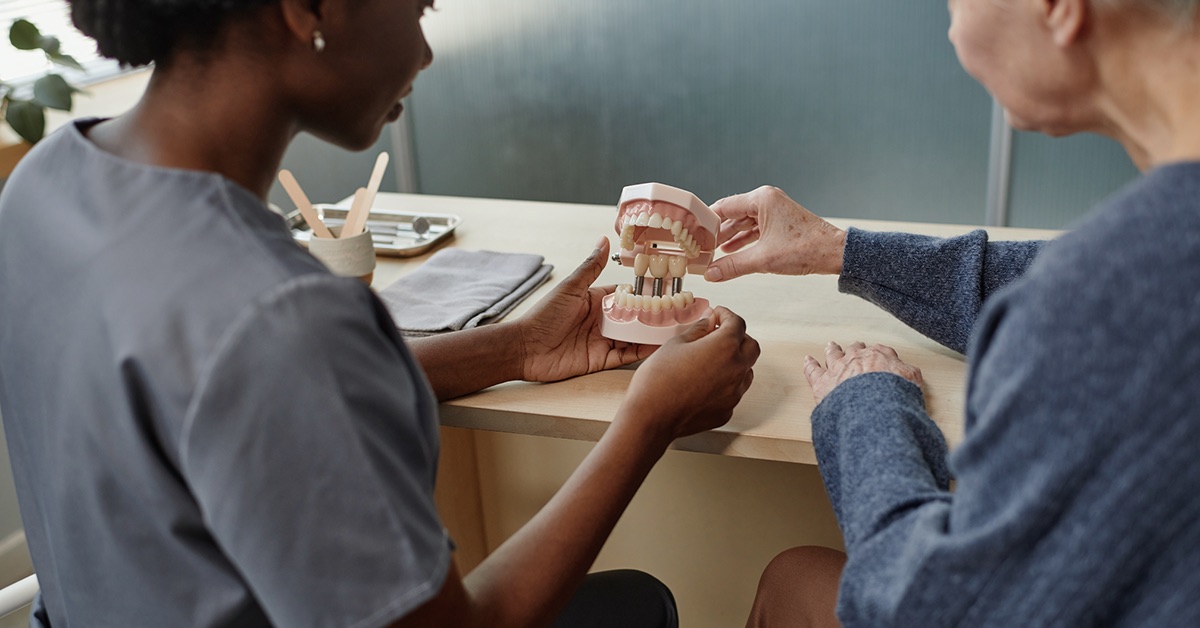
The honest answer: many implant patients feel close to normal within a few days. Full bone integration around the implant takes several months, and that is the part you cannot rush.
The most common thing I hear in the post-op chair after an implant surgery is some version of: “That was easier than I expected.” Patients walk in braced for something close to oral surgery from a horror movie. Then they walk out with a numb cheek, a printed list of instructions, and a slight bewilderment that the experience was so unremarkable.
Most dental implant recovery is genuinely uneventful. But “uneventful” does not mean nothing happens. There is a real week-by-week arc, with predictable moments of soreness, predictable diet shifts, predictable milestones, and a handful of things to watch for that warrant a phone call. This guide walks through all of it honestly, from the moment you leave our office on surgery day through the final restoration months later.
If you are still deciding whether implants are right for you, start with our dental implants overview before reading further. This article assumes you are either scheduled for the procedure or seriously considering it.
A quick promise: this is the recovery experience we describe to our own patients before they consent to the procedure. There is no marketing version of recovery and a real version. There is just one timeline, and you deserve to know what it actually looks like.
What does dental implant recovery look like week by week?
For many people, soreness is worst in the first few days. After that, the bone bonds to the implant over several months while you live your normal life (AAOMS). A bone graft can add time.
| Time after surgery | What is common | What helps |
|---|---|---|
| Surgery day | Numbness wears off over a few hours, then soreness starts. | Rest at home, use a cold pack on the outside of your jaw, and take a pain reliever as we direct. After oral or IV sedation, an adult must drive you home (MedlinePlus). |
| Days 2 to 7 | Soreness and swelling are common in the first few days, then ease for many people. Some people bruise. | Eat soft foods, cold foods or warm soup (ADA), and chew away from the implant. Follow your aftercare sheet for rinsing and brushing. |
| Weeks 2 and 3 | Many people are back to work, meals and exercise. The gum is still healing. | Brush the area gently. Ask us before heavy lifting or contact sports. |
| Weeks 4 to 12 and beyond | Bone bonds to the implant (osseointegration). This often takes 3 to 6 months and can take longer (Cleveland Clinic; FDA). | Brush and floss normally, keep your check-ins, and call us if the implant feels loose. |
| After healing | Your final crown, bridge or denture is attached to the implant. | Brush twice a day, clean between your teeth every day, and get a cleaning and exam every 6 months. |
This is a general guide for a single implant, and healing times vary from person to person. Full-arch treatment such as All-on-X follows its own plan, which Dr. Dennis explains at your consultation. If your aftercare sheet says something different, follow the sheet.
The First 24 Hours
The procedure is done under local anesthetic, with oral or IV sedation available if you want it. Sedation is not general anesthesia. Most patients arrive without much anxiety once we walk through what we are doing, and most leave feeling slower from the anesthetic than from the actual surgery.
The first hour after you leave our office, the local anesthetic is still working and you will not feel much. We send you home with a printed instruction sheet, an ice pack, and a list of things to avoid (no straws, no spitting forcefully, no smoking, no vigorous rinsing). You should plan to spend the rest of the day resting at home. If you had oral or IV sedation, an adult needs to drive you home.
How painful is it after a dental implant?
Soreness and swelling for the first few days are common, and for many people they ease within the first week. Pain that gets worse after day 3 is not typical, so call us if that happens.
The numbness wears off over 3 to 6 hours. Mild discomfort starts then. We typically recommend taking an over-the-counter pain reliever such as ibuprofen, as we direct, before the anesthetic fully wears off so you stay ahead of the pain rather than trying to catch up to it. Use a cold compress on the outside of the jaw for 20 minutes on, 20 minutes off, for the first several hours. This helps keep swelling down.
By bedtime, most patients have managed their discomfort with over-the-counter pain medication and a soft dinner. Soreness is real but it is not the throbbing pain people sometimes brace for. If you are uncomfortable enough that you cannot sleep, call us. That is unusual, and we will rule out any complications.
Week One: The Soft Food Week
The first full week after surgery is the most attention-required period of the whole recovery. Most of that attention is dietary.
What can I eat after dental implant surgery?
Start with soft, cool foods and chew on the other side of your mouth. The ADA notes that dentists may suggest soft foods, cold foods and warm soup while you heal.
For the first 24 to 48 hours, stick to truly soft foods that require no chewing on the surgical side: smoothies, yogurt, scrambled eggs, mashed potatoes, soups (warm, not hot), oatmeal, mashed avocado, applesauce. Avoid anything crunchy, anything seedy (raspberries, strawberries, popcorn), anything chewy (steak, bread crust), and anything that requires biting into (corn on the cob, apples). The wound site needs to stay undisturbed while a small blood clot forms and the initial healing begins.
By day 3 or 4, you can usually expand to softer chewable foods, still avoiding the surgical site. Soft pasta, fish, well-cooked vegetables, soft fruits without skins or seeds. By the end of week one, most patients are eating most of their normal diet, just being a little careful around the implant site.
Carla, a 52-year-old patient, told us at her week-one check-in that the hardest part of recovery was the food restriction, not the pain. She had two single-tooth implants placed in one appointment. The actual discomfort was gone within 72 hours. The smoothie phase lasted longer than the soreness did.
Other week-one realities:
- Mild swelling often peaks at 48 to 72 hours, then eases over the next 4 to 5 days.
- Bruising can appear on the cheek or jawline for some patients, typically a yellow-green color that fades over a week.
- Brushing your other teeth is fine. Avoid the implant site directly with the toothbrush for the first 3 to 5 days.
- Saltwater rinses (1/2 teaspoon salt in 8 oz warm water) can be used gently after day 1, several times a day.
- Sleep with your head slightly elevated for the first 2 nights to reduce swelling.
Pain medication needs typically drop sharply after 48 hours. By day 5, most patients are no longer taking anything for pain.
When to call us in week one
- Bleeding that does not stop after 30 minutes of firm pressure on a gauze pack
- Swelling that is increasing on day 3 or 4 instead of decreasing
- Pain that is worsening instead of improving after day 3
- Fever above 100.5°F
- Numbness or tingling that does not resolve as the local wears off
- A bad taste in the mouth or pus around the surgical site
These are uncommon, but if you notice any of them, call us right away at (518) 584-5060.
Weeks Two and Three: Back to Normal
By the start of week two, most patients are back to their normal lives. Eating, talking, exercising, working, smiling normally. The surgical site is still healing, but you forget about it most of the time.
Brush the implant site gently with a soft toothbrush. We sometimes prescribe a chlorhexidine rinse to use twice daily for the first 7 to 14 days, depending on the case. Flossing around the implant site is restricted for the first 2 weeks. Then it resumes normally.
You will likely see us for a short check-in around week 2 to remove any sutures if they were placed and to confirm the site is healing well. This is not a painful or stressful appointment.
Some patients describe a strange sensation that the implant site feels “different” for these first two weeks, like there is something there that is not quite a tooth. That is the temporary cover or healing abutment we placed during surgery. It is doing its job protecting the implant while the bone heals around it.
Exercise is generally fine after day 4 or 5. Heavy lifting and contact sports should wait until week 2 or 3 to avoid bleeding or accidentally bumping the site. Swimming is fine. Saunas and hot tubs should wait until week 2.
Weeks 4 Through 12: The Quiet Phase
After the third week, the visible healing is essentially complete. From your perspective, life is normal. From the implant’s perspective, the most important work is happening invisibly: osseointegration.
Osseointegration is the slow process where your jawbone fuses to the titanium surface of the implant. The bone cells migrate into and around the implant’s textured surface, and over weeks and months they create a strong, lasting bond. This is what makes a dental implant fundamentally different from a bridge or denture. It is also why the timeline cannot be rushed.
Implants often bond with the bone in 3 to 6 months (Cleveland Clinic), and for some people it takes longer (FDA). If you needed a bone graft, healing can take longer too. Your specific timeline depends on your bone density, your health, your age, and whether grafting was involved.
If you had a bone graft, you are in the same phase but with slightly different rules. See our bone grafting guide for the full timeline for grafted cases.
During this quiet phase, you continue brushing and flossing normally. You eat normally. You can resume any activity. You may have one or two short check-in appointments to confirm progress with a clinical exam and possibly a 3D scan to check bone density around the implant.
David, a 64-year-old patient, said the hardest thing about months 2 through 4 was that nothing felt like it was happening. He kept poking at the site with his tongue expecting to feel something, and there was just a small, healed-over bump where the implant was integrating quietly. He was right that nothing dramatic was happening. The bone was doing the real work.
What you might notice (and what you should not worry about)
Normal during this phase:
- A small bump or rise of gum tissue over the implant
- Slight color difference in the gums right around the implant
- Occasional awareness of the implant when chewing certain foods
- Feeling like the implant area is slightly less sensitive than the surrounding teeth (it is; implants do not have nerves)
Not normal during this phase (call us):
- Looseness in the implant
- Pain that returns after being gone
- Bleeding around the implant site
- Swelling that returns
- Gum recession around the implant (changes the visible color line)
- A bad taste persisting
The Restoration Phase
Once osseointegration is complete (often 3 to 6 months after surgery), it is time for the final step: placing your custom-made tooth on top of the implant. This phase happens across one or two short appointments and is not surgical in any meaningful sense.
At the first restoration appointment, we take an impression of your mouth. This data goes to a dental lab that fabricates your custom crown (or bridge, or denture in the case of multiple implants). The lab work usually takes a few weeks.
At the second restoration appointment, the crown is attached to the implant. Depending on the system used, it is either screwed in or cemented on. This is a short appointment, no anesthetic needed in most cases, and you walk out with the final tooth in place. From this point forward, you treat the implant like any other tooth.
This is also where the cost transparency we promised at the consultation gets confirmed: the restoration phase is part of the written estimate you received before treatment started.
The first time you bite down on the new tooth and chew normally, most patients describe it as “weird in a good way.” It feels like a real tooth, but you remember that you spent the last few months without one there. The brain adjusts within a day or two.
Long-Term Care After the Implant Is Restored
After the restoration is in place, your implant is essentially done. The maintenance is the same maintenance that protects natural teeth.
Brush twice a day with a soft toothbrush. Floss daily, including around the implant. Many patients find a water flosser (Waterpik or similar) helpful for cleaning under the implant crown where regular floss can be tricky. Come in for professional cleanings and exams every six months.
That is the entire maintenance program. Implants cannot get cavities because they are titanium. But the gum and bone around them can still develop infection (peri-implantitis) if oral hygiene slips, in the same way that gum disease can affect natural teeth. When implants run into trouble years later, gum and bone infection linked to hygiene is a common reason.
If you grind your teeth at night, tell us. Heavy grinding can wear down or even crack a crown, whether it is on an implant or a natural tooth.
A Quick Reality Check on Recovery Length
Patients sometimes ask why implants take so long compared to a crown or a bridge. The honest answer: because the bone has to fuse to the implant, and there is no way to speed up biology. Bone heals at its own pace.
The other honest answer is that the recovery experience is concentrated mostly in the first week. The months that follow are not really “recovery” in any active sense. You are just waiting for the bone to do its work while you live your normal life.
Compared to the alternatives:
- A dental bridge is usually faster to finish. But the healthy teeth next to the gap must be ground down, and a bridge lasts 5 to 15 years on average (Cleveland Clinic).
- A denture is usually faster to finish, but can slip, may need adhesive, and can speed bone loss over time.
- An implant often takes 3 to 6 months to heal (Cleveland Clinic). With good care it can last many years, and the teeth next to it do not need to be reshaped.
Compare them honestly side by side at our implants vs. bridges guide if you are still weighing the options.
What Makes Recovery Smoother
A few things we tell every patient before surgery:
Take your prescribed medications. We usually do not prescribe narcotic pain medication for routine implant cases. When we do prescribe something, take it as directed.
Avoid tobacco for at least 2 weeks before and 2 weeks after surgery, ideally longer. Smoking is one of the biggest risk factors you can control. One research review found implant failure was about twice as common in smokers as in nonsmokers (Chrcanovic 2015 review).
Stay hydrated. Eat enough soft food in week one to maintain your normal calorie intake. The body needs nutrients to heal. Skipping meals can slow healing.
Sleep enough. Good sleep helps your body heal.
Keep your follow-up appointments. They are short, and they catch small issues before they become big ones.
Key Terms in Dental Implant Recovery
- Osseointegration
- The healing process in which jawbone grows onto the implant and bonds with it. It usually takes several months (AAOMS).
- Titanium implant post
- The small post placed in the jawbone that takes the place of a tooth root. Implants are medical devices, and the FDA suggests asking for the brand and model and keeping it with your records.
- Abutment
- The connector at the gumline that joins the implant post to the crown, bridge or denture. While the bone heals, a small healing cap (a healing abutment) may sit on the implant instead.
- Implant crown
- The tooth you see and chew with. On a single tooth implant, it attaches to the abutment after the bone has healed.
- Bone grafting
- Adding bone or bone-like material where the jaw is too thin to hold an implant. A graft can add healing time.
- 3D CBCT scan
- Cone beam computed tomography: a 3D X-ray of your jaw. Dr. Dennis uses it to see your bone and plan where the implant goes.
- Oral and IV sedation
- Medicine that helps you relax during treatment, taken as a pill (oral) or given through a vein (IV). It is not general anesthesia, and an adult must drive you home after it.
- Peri-implant mucositis
- Red, swollen or bleeding gums around an implant, without bone loss. It is milder than peri-implantitis, an infection that also affects the bone around the implant (Derks 2015).
Frequently Asked Questions
How long does dental implant recovery actually take?
The active recovery, when you notice soreness and eat soft foods, is often about 5 to 7 days. Full healing, including osseointegration of the bone to the implant, often takes 3 to 6 months and can take longer (Cleveland Clinic; FDA). The final restoration is placed at the end of that period. Many patients are back to normal life within a week of surgery.
Can I work the day after implant surgery?
Often, yes, especially if you have a desk job. We recommend taking the day of surgery off to rest, and many patients return to work the next day. If you have a physically demanding job, plan to take 2 to 3 days off. Heavy lifting and contact sports should wait until week 2 or 3. If you had oral or IV sedation, general guidance is not to drive for at least 24 hours (MedlinePlus).
How long after dental implants can I eat normally?
By the end of week one, most foods are back on the menu, as long as you chew away from the implant. You chew on the implant itself after the final crown is placed, often 3 to 6 months after surgery. From then on, many people eat much as they did before, including apples and steak.
What is osseointegration and why does it take so long?
Osseointegration is the biological process where your jawbone fuses to the titanium implant. Bone grows onto the textured surface of the implant and bonds with it. This often takes several months. This timeline is set by biology, and there is no way to rush it. The wait is what lets the implant work like a natural tooth root for many years after.
What happens if my implant feels loose during recovery?
Call us. A truly loose implant during recovery is unusual, and we will want to check it soon. Sometimes what feels like looseness is actually the healing abutment that protects the implant, which can move slightly. We will examine the area, take a quick scan if needed, and determine whether it is normal or needs attention.
Does smoking slow healing after implant surgery?
It can. The FDA notes that smoking may affect healing after implant surgery. In one large review, 6.35% of implants placed in smokers failed, compared with 3.18% in nonsmokers, though other factors may play a part (Chrcanovic 2015). We ask you to avoid tobacco for at least 2 weeks before and 2 weeks after surgery.
More questions about visits, payment or sedation? See our patient FAQs.
Ready to Schedule Your Implant Consultation?
If you have been putting off implants because you were not sure what the recovery would actually look like, hopefully this guide gives you a clearer picture. The hardest part of implant recovery is usually the first week of soft food. The rest of the timeline is quiet healing while you live your normal life.
A consultation is the next step. We do a 3D CBCT scan, review your specific case, walk you through the timeline that applies to you, and give you a written cost estimate. There is no expectation that you make a decision on the spot.
If you are still in research mode, our dental implants overview and our implants vs. bridges comparison are both good next reads. If you have been told you might need a bone graft first, see the bone grafting guide.
Your next step: an implant consultation in Saratoga Springs
Saratoga Smiles is a fee-for-service dental office at 6 Carpenter Lane, Saratoga Springs, NY 12866, led by Dr. Richard L. Dennis, DMD, MAGD. We see patients from Saratoga Springs, Wilton, Ballston Spa, Malta, Greenfield and the surrounding Capital District.
The consultation has a fee, which we confirm when you book.
Using insurance? You can use out-of-network benefits if your plan has them, plus HSA or FSA funds. You can also use Proceed Finance, Cherry or CareCredit if the lender approves you. See our insurance and payment options.
Hours: Monday to Wednesday, 8 a.m. to 5 p.m.; Thursday, 9 a.m. to 3 p.m. Already a patient with a question after surgery? Call the office at (518) 584-5060.
Sources
- American Association of Oral and Maxillofacial Surgeons (AAOMS). Dental Implant Surgery.
- American Dental Association, MouthHealthy. Implants.
- Cleveland Clinic. Dental Bridges.
- US Food and Drug Administration (FDA). Dental Implants: What You Should Know.
- MedlinePlus, US National Library of Medicine. Conscious sedation for surgical procedures.
- Chrcanovic BR, Albrektsson T, Wennerberg A. J Dent, 2015. Smoking and dental implants: a systematic review and meta-analysis.
- Derks J, Tomasi C. J Clin Periodontol, 2015. Peri-implant health and disease: a systematic review of current epidemiology.