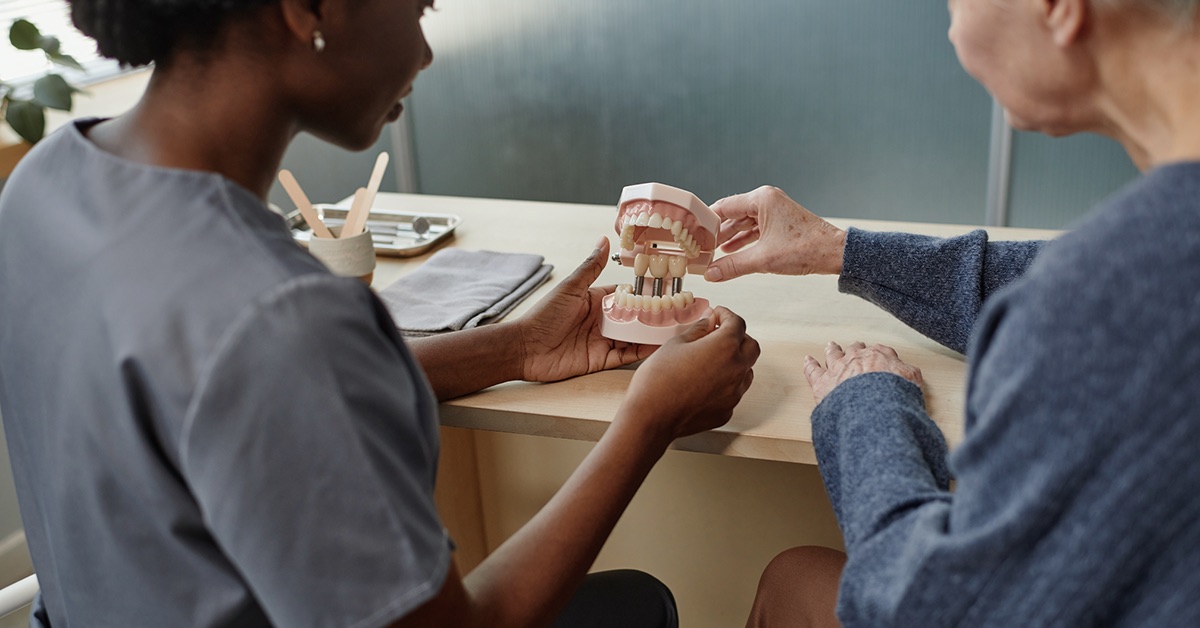
The honest answer: bone grafting is often what makes an implant possible when the jaw has lost bone from an old extraction or a long-term missing tooth. It is a routine, low-complication procedure that adds several months to your treatment timeline but produces the foundation implants need to succeed long-term.
Margaret came in last spring after wearing the same upper denture for 15 years. She had been told three times by three different dentists that her jawbone was too thin for implants and that her only option was another denture. The fourth opinion was different. A 3D scan showed she had enough bone for two implants in the front and needed a small graft for the back. Several months later she was eating an apple again, something she had not done since 2010.
If you have been told you do not have enough bone for dental implants, this article is for you. Bone grafting sounds intimidating. It usually is not. Most grafts are routine, the materials are safe, and the recovery is far shorter than people expect. The goal here is to give you a clear, honest picture of what a graft actually is, when you need one, how the fee is set, and the cases where you can skip it entirely. If you are not sure whether grafting fits your situation, you can start with our dental implants overview and come back to this guide once you have the basics.
One promise before we dive in: at Saratoga Smiles, we do not recommend grafting unless your scan shows it is needed. We have sent more than a few patients home with the good news that no graft is required.
Why Bone Loss Happens (And Why It Matters for Implants)
Your jawbone is a use-it-or-lose-it tissue. Natural teeth stimulate the bone every time you chew, and that stimulation tells the bone to stay dense and full. The moment a tooth comes out, that stimulation stops, and the body starts to break down and reabsorb the bone in that spot.
The pace is faster than most people realize: one review found the bone lost 29 to 63 percent of its width within about 6 months after a tooth was removed (Tan and colleagues, 2012), and the process keeps going year after year. Long-term denture wear accelerates the loss in a different way. A denture rests on the gums and presses down on the bone underneath, which speeds up resorption rather than slowing it. Periodontal disease (severe gum infection) destroys bone too, often before the tooth itself fails.
All of this matters for implants because a dental implant is a titanium post placed into the jawbone. The post needs bone all the way around it to fuse properly, a process called osseointegration. If the bone is too thin or too short for the implant to anchor securely, the implant will not hold, and that is where grafting comes in. We rebuild the missing bone first, then place the implant.
What Is a Dental Bone Graft?
A dental bone graft is a procedure where bone or a bone-like material is placed into an area of your jaw where bone is missing. Over the next few months, your body integrates the graft, growing new natural bone around and through it. By the time it is fully healed, the area is dense and full again, ready to support a dental implant.
The grafting material is usually one of four types:
- Allograft: processed donor bone from a tissue bank. Sterile, safe, and the most commonly used option. Your body uses it as a scaffold and replaces it with your own bone over time.
- Xenograft: bone from another species, typically bovine. Also sterile and routine. It integrates more slowly but holds the space well during healing.
- Autograft: your own bone, harvested from elsewhere (chin, jaw, or hip). Your body accepts it well, but it requires a second surgical site, so it is usually saved for complex cases.
- Synthetic: lab-made mineral materials. Used in smaller defects or as an additive.
Most patients receive an allograft or xenograft. Both are safe, both are widely used, and both have decades of successful use behind them. We will tell you exactly what we are recommending and why before we ever start.
When You Need a Bone Graft (And When You Don’t)
This is where it pays to slow down. Not every implant candidate needs a graft, and the marketing on this topic is often a little aggressive.
You probably need a graft if:
- The tooth was extracted more than a year ago and nothing was done at the time
- You have worn a removable denture for many years in that area
- You had severe periodontal disease around the missing tooth before it was lost
- Your CBCT scan shows the bone is too thin (narrow) or too short (height) for an implant
- The upper-back-tooth space has been taken over by an expanded sinus (sinus lift territory)
You probably do not need a graft if:
- The tooth was extracted recently and your dentist preserved the socket at the time
- Your scan shows healthy, dense bone in the area
- You are a candidate for All-on-X full-arch implants (this approach can often avoid grafting by angling the back implants into existing dense bone)
The most honest thing we can tell you is this: a 3D CBCT scan is the only way to know for sure. We have had patients walk in convinced they needed an extensive graft, only to find on the scan that they had enough bone for a straightforward implant. The reverse is true too. The scan is the ground truth.
The Four Types of Bone Grafts You Might Hear About
Different situations call for different graft procedures. Here is what each one is for.
Socket Preservation
This is the simplest, cheapest, and most preventative type of graft. It is performed at the same appointment as a tooth extraction, before bone has a chance to start receding. A small amount of graft material is packed into the empty tooth socket right after the tooth comes out, and a tiny collagen plug seals it.
Socket preservation is often worth doing if there is any chance you might want an implant later. It is a small step that can help you avoid more complex grafting down the road. Even if you decide later that an implant is not for you, the bone is still preserved for a future bridge or denture.
Ridge Augmentation
This is what most people think of when they hear “bone graft.” A ridge augmentation rebuilds the width or height of the jawbone in an area where the tooth has been gone for years. The graft material is placed against or on top of the remaining bone, covered with a protective membrane, and given several months to heal. After that, the implant is placed.
Ridge augmentation is a common graft for patients who have lived with a gap for years. The procedure is straightforward for most patients, and the recovery is usually mild.
Sinus Lift
A sinus lift is specifically for upper-back-tooth implants. In the upper jaw, the maxillary sinus sits right above the back molars and premolars. When a back tooth is lost, the sinus tends to expand downward over time, leaving very little bone for an implant.
A sinus lift gently moves the sinus membrane upward and packs graft material into the new space. It sounds dramatic, but it is a common, routine procedure. Many patients find the recovery easier than they expected.
PRP or PRF (Platelet-Rich Plasma or Fibrin)
These are not standalone grafts, but additives. A small sample of your own blood is drawn at the appointment, spun in a centrifuge, and the growth-factor-rich layer is added to the graft material. It may help healing and graft integration in larger procedures. Not every case needs it.
What to Expect From the Procedure
Tom, a 54-year-old patient, came in needing a single implant for an upper-back tooth he had lost two years earlier. His scan showed his sinus had expanded into the space and he needed a sinus lift before the implant could go in. Here is what his experience looked like.
The graft procedure itself took about 75 minutes under local anesthetic with mild oral sedation. Someone else drove him home because of the sedation, and he was back to a desk job two days later. He took ibuprofen for the first three days, ate soft foods for about a week, and felt mostly normal by day five. The graft healed over several months, his implant was placed, and a few months after that he had a new crown.
Total timeline: several months from first appointment to final crown. That sounds long, but his active appointment time totaled only a few hours across three visits. Most of that time was just healing.
For most patients, the post-op experience is mild swelling for a few days, soreness that responds well to over-the-counter pain medication, a soft-food diet for about a week, and a return to normal activity within a few days. The healing window before the implant goes in is several months, depending on the size and type of graft.
How Much Does a Bone Graft Cost in Saratoga Springs?
Cost is a fair question. Your fee depends on your exam and the treatment you choose. You get a written estimate before treatment starts. These things change the fee:
- The type of graft: socket preservation, ridge augmentation or sinus lift
- The size of the graft and how much bone needs to be rebuilt
- The graft material used
- Whether other procedures, such as an extraction, are done at the same time
Many dental plans cover at least part of a graft when it is medically necessary for an implant, especially socket preservation done at the time of extraction. Medical insurance occasionally helps when the bone loss is tied to disease or trauma. We are a fee-for-service office, so we are not in-network with any insurance plan, but you can still use your out-of-network benefits, and our team walks you through the claim process. HSA and FSA funds can help with what insurance does not cover, and financing is available through Proceed Finance, Cherry or CareCredit if the lender approves you.
A graft is usually part of the larger implant treatment plan, so you get one written estimate for the entire path from where you are now to a finished implant.
What Happens If You Skip the Graft?
The honest answer: most often, the implant cannot be placed. Either there is not enough bone for the implant to anchor in, or the implant goes in but fails within a year or two because the bone around it was too thin to hold long term.
A common scenario we see: a patient is told they need a graft, decides to wait and think about it, and comes back two or three years later. By then the bone loss has progressed and the graft they need is bigger, more complex, and more expensive than the graft they could have had originally. Waiting rarely makes treatment cheaper. It usually makes it more invasive.
There are exceptions. If you have decided you do not want an implant and a bridge or denture is your replacement plan, you may not need a graft at all. If you are an older patient with a stable bite and no plan to replace the tooth, you may be fine leaving things alone. The decision should be yours, not pressured into.
Bone Grafting at Saratoga Smiles
Dr. Dennis takes a conservative approach to grafting, the same approach that defines the rest of our practice. We do not recommend a graft unless the scan shows it is needed, and when we do recommend one, we will tell you exactly why, what material we will use, and what the alternatives are.
A few practical things that matter for graft success:
We use 3D CBCT planning before every grafting case. Without it, you are working from guesses. With it, we can see the exact dimensions of the bone you have and the bone you need, plan the graft precisely, and minimize the procedure to only what is actually required.
Because we are fee-for-service, we choose graft materials based on what works best for your specific case, not on what an insurance contract reimburses at the highest margin.
If we look at your scan and a graft is not needed, we will say so. We have sent patients home with the good news that they can move straight to implant placement. Meet Dr. Dennis to learn more about how we approach implant cases.
Frequently Asked Questions
How painful is a dental bone graft?
For most patients, much less than expected. The procedure itself is done under local anesthetic, with sedation available if you prefer. Post-op discomfort is usually mild, peaks at 24 to 48 hours, and responds well to over-the-counter ibuprofen. Patients commonly tell us it was easier than the tooth extraction that came before it.
How long does a bone graft take to heal before an implant can be placed?
Most grafts need several months to heal. A small socket graft often heals faster than a ridge augmentation or a sinus lift. We check the graft before placing the implant, so the healing, not the calendar, sets the timing.
Will my insurance cover a bone graft?
It depends on the plan. Many dental plans cover at least part of a graft when it is documented as medically necessary for an implant, particularly socket preservation at the time of extraction. Medical insurance occasionally covers grafting when bone loss is tied to disease or trauma. We are a fee-for-service office, so we are not in-network with any insurance plan, but you can still use your out-of-network benefits. Our team walks you through the claim process.
Can I have the implant placed at the same time as the bone graft?
Sometimes. If the bone defect is small and the remaining bone is dense enough to stabilize the implant, both may be placed in one visit. If the defect is larger, the graft needs to heal first before the implant goes in. The scan tells us which approach is right for your specific case.
How often do dental bone grafts work?
Most bone grafts heal well in healthy patients. Failures are uncommon and usually trace to heavy smoking, uncontrolled diabetes, or infection at the site. When a graft does fail, it can often be repeated.
Is donor bone safe?
Yes. Allograft material comes from licensed tissue banks that follow rigorous sterilization, screening, and processing standards established by the FDA and the American Association of Tissue Banks. The material is biologically inert by the time it reaches your jaw, and it serves as a scaffold for your own bone to grow into. It has been used in dentistry for decades.
How long after a tooth extraction can you wait to get a bone graft?
The best window for a preventative socket preservation graft is at the time of the extraction itself. After that, the next-best window is within the first few months, before more bone is lost. After a year, you are typically looking at a more involved ridge augmentation rather than simple socket preservation. The sooner, the easier.
Are there options if I don’t want a bone graft?
Yes. All-on-X full-arch implants can often avoid grafting by angling the back implants into existing dense bone. For single missing teeth, a traditional bridge or partial denture remains an option. We will walk through every alternative honestly during your consultation and recommend the path that fits your case and your goals.
Ready to Find Out If You Need a Bone Graft?
If another dentist has told you that you cannot get implants because of bone loss, we would like a closer look at your case. The consultation has a fee and includes a 3D CBCT scan and a conversation about what your options actually are. Our team confirms the fee when you book. There is no expectation that you make a decision on the spot. Many patients leave with a plan, take it home to think about for a few weeks, and come back when they are ready.
If you know you want to move forward with implants and just need to figure out the grafting piece, schedule a consultation or call us at (518) 584-5060. If you are still in research mode, our dental implants overview covers the bigger picture.
Saratoga Smiles is a fee-for-service dental practice at 6 Carpenter Lane in Saratoga Springs, led by Dr. Richard Dennis. We see patients from Saratoga Springs, Wilton, Ballston Spa, Malta, Greenfield, and the surrounding Capital District.