
Margaret had been living with a gap in her smile for almost three years. The lower molar she lost to a fracture in 2023 never seemed urgent enough to address. Then her dentist in Albany told her the bone beneath the missing tooth had already started to thin. If she waited much longer, she would need bone grafting before an implant could even be considered. That conversation changed everything.
If you have been putting off replacing a missing tooth, you are not alone. Most patients we see at Saratoga Smiles have spent months, sometimes years, weighing their options. The questions are always similar: Will it hurt? How much does it cost? How long does it take? Will it actually look and feel like a real tooth?
This guide answers all of those questions directly. You will learn what dental implants are, which types are available, how the process works at our Saratoga Springs practice, what they cost, and how to determine whether you are a good candidate. We wrote this so you can walk into your consultation already informed, not overwhelmed.
What Are Dental Implants?
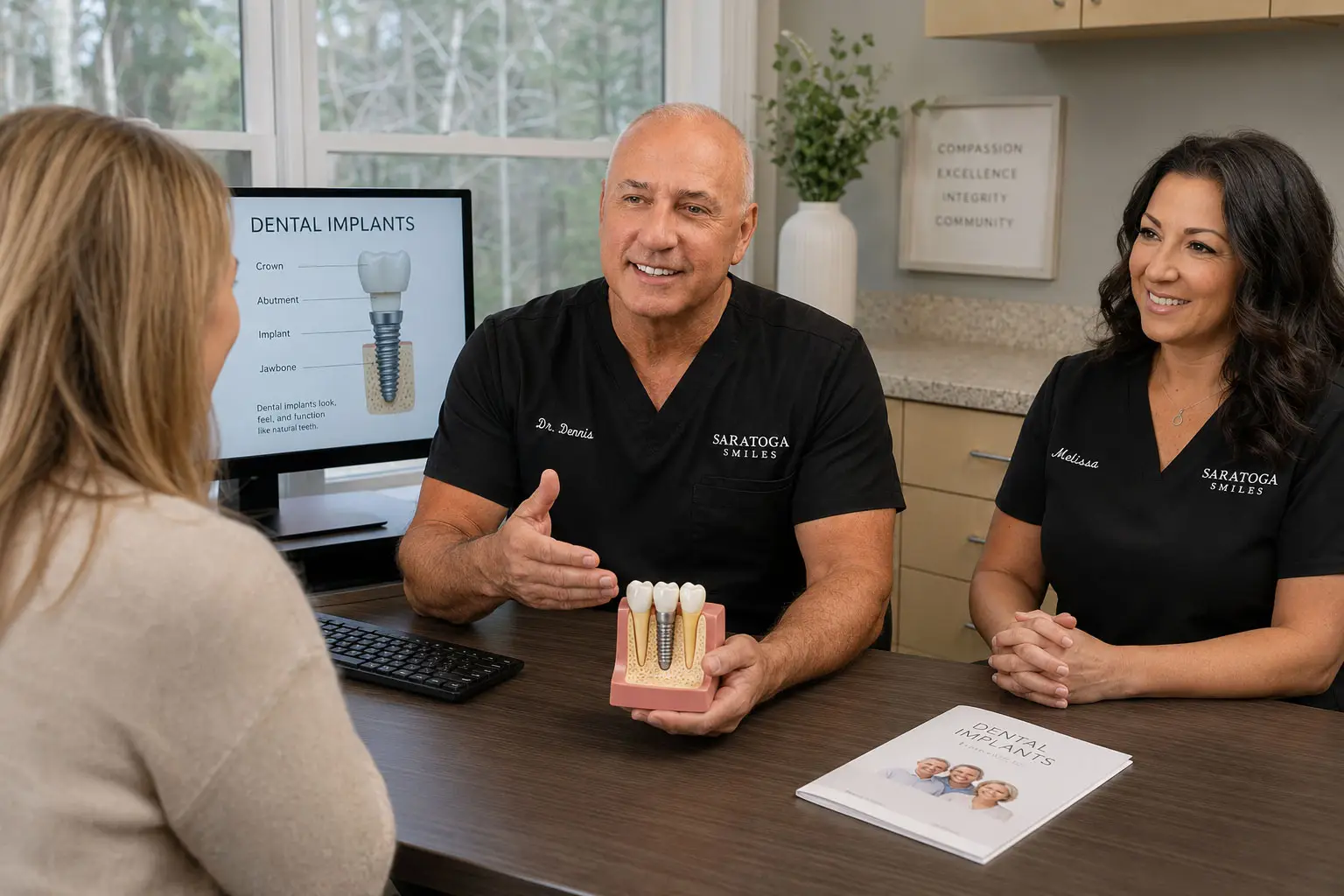
A dental implant is a titanium post surgically placed into the jawbone to replace the root of a missing tooth. Once the post integrates with the bone through a process called osseointegration, a custom crown, bridge, or denture is attached to restore both function and appearance.
Unlike removable dentures or traditional bridges, implants are anchored directly in bone. They do not shift, slip, or require adhesives. They do not rely on adjacent teeth for support. And because the titanium post stimulates the jawbone the same way a natural root does, implants help prevent the bone deterioration that follows tooth loss.
According to research published in the Journal of Dental Research, dental implants have a success rate between 95% and 98% over a 10-year period. With proper care, many implants last 25 years or longer.
Nearly 3 million Americans currently have dental implants, and that number grows by approximately 500,000 each year. The reason is straightforward: implants are the closest thing modern dentistry offers to a natural, permanent tooth replacement.
Considering implants? Schedule a consultation with Dr. Dennis or Dr. Dennis to discuss your options. No pressure, no commitment.
Types of Dental Implants We Offer in Saratoga Springs
Not every missing tooth requires the same solution. The right implant approach depends on how many teeth are missing, where they are located, and the condition of your jawbone.
Single Tooth Implants
When one tooth is missing, a single implant replaces both the root and the crown. This is the most common implant procedure. The titanium post is placed in the jawbone, allowed to heal for three to six months, and then topped with a porcelain crown that matches your surrounding teeth in color, shape, and size.
Single implants preserve the teeth on either side. Unlike a traditional dental bridge, no adjacent teeth need to be filed down or altered.
Implant-Supported Bridges
When two or more adjacent teeth are missing, an implant-supported bridge eliminates the gap without affecting healthy neighboring teeth. Two implant posts anchor a connected row of replacement teeth, distributing bite force evenly across the bridge.
Implant-Retained Dentures
For patients missing most or all teeth in an arch, implant-retained dentures offer a stable alternative to traditional removable dentures. Four to six implants anchor a full set of replacement teeth that snap into place securely. No adhesives, no slipping, no daily removal.
Full Arch (All-on-4) Solutions
The All-on-4 approach replaces an entire arch of teeth using just four strategically angled implants. This technique works even for some patients with moderate bone loss, because the angled posts maximize contact with available bone. In select cases, temporary teeth can be attached the same day as surgery.
Dental Implants vs. Bridges vs. Dentures
Patients often ask us how implants compare to other tooth replacement options. The differences are significant.
| Factor | Dental Implants | Traditional Bridge | Removable Dentures |
|---|---|---|---|
| Lifespan | 25-30+ years | 5-15 years | 5-8 years |
| Bone preservation | Yes, stimulates jawbone | No | No, accelerates bone loss |
| Adjacent teeth affected | None | Requires filing neighboring teeth | None |
| Stability | Fixed, permanent | Fixed | May slip or shift |
| Maintenance | Brush and floss normally | Special flossing required | Daily removal and cleaning |
| Cost (long-term) | Higher upfront, lower lifetime cost | Moderate | Lower upfront, higher replacement cost |
David, a patient in his early 60s, came to us after wearing an upper denture for four years. He described the constant worry about his denture loosening during meals and conversations. After placing four implants and securing a fixed restoration, he told us the difference was not just physical. “I stopped thinking about my teeth entirely,” he said. “That was the point.”
We do not recommend implants in every situation. A dental crown may be sufficient for a damaged tooth that still has a healthy root. A bridge may make sense in specific clinical scenarios. Our approach is always to recommend the most conservative, appropriate solution for your situation.
The Dental Implant Process at Saratoga Smiles
Every implant case at our practice follows a structured, four-stage process. We do not rush any step, and we keep you informed throughout.
Step 1: Comprehensive Consultation and Treatment Planning
Your first visit includes a detailed oral examination, digital X-rays, and a CBCT (cone beam) scan that produces a three-dimensional image of your jaw. We evaluate bone density, gum health, bite alignment, and the position of adjacent teeth.
Based on this assessment, Dr. Dennisdevelops a personalized treatment plan. We discuss which type of implant is appropriate, whether bone grafting is needed, the expected timeline, and the full cost before any work begins.
Step 2: Implant Placement Surgery
The titanium post is placed into the jawbone during a minor surgical procedure. Most patients choose local anesthesia, though IV sedation is available for patients who prefer to be fully relaxed during surgery.
The procedure typically takes 30 to 60 minutes per implant. Most patients report that the discomfort is less than they anticipated, comparable to having a tooth extracted.
Step 3: Healing and Osseointegration
After placement, the implant needs three to six months to fuse with the surrounding bone. During this healing period, a temporary restoration may be placed so you are never without a tooth.
This is the step that requires patience, and it is the step that determines long-term success. Osseointegration is what makes an implant permanent. Rushing it compromises the foundation.
Step 4: Final Restoration
Once the implant has fully integrated, we attach the permanent crown, bridge, or denture. The restoration is custom-fabricated to match your natural teeth in color, shape, and size. We make fine adjustments to your bite to ensure comfortable, even contact.
Ready to start the process? Contact our office or call (518) 584-5060 to schedule your implant consultation.
Am I a Good Candidate for Dental Implants?
Most adults with one or more missing teeth are candidates for implants. Ideal candidates have:
- Adequate jawbone density to support the implant post
- Healthy gums free of active periodontal disease
- Good overall health (no uncontrolled systemic conditions)
- A commitment to oral hygiene and regular dental visits
Certain conditions require evaluation before proceeding. Patients with diabetes, those who smoke, and those who have undergone radiation therapy to the head or neck need additional assessment. These conditions do not automatically disqualify you, but they affect healing and must be managed.
Bone loss does not necessarily rule out implants. Bone grafting procedures can rebuild the jawbone to support implant placement. Without treatment, the jawbone can lose up to 25% of its volume within the first year after tooth loss, which is why earlier evaluation often leads to simpler treatment.
We are honest with our patients. If implants are not the right solution for your situation, we will tell you. Our conservative, patient-first approach means we recommend only what is clinically appropriate and designed to last.
How Much Do Dental Implants Cost in Saratoga Springs?
We believe you deserve a clear answer about cost before making any decisions. Here are the factors that determine what dental implants cost in the Saratoga Springs area:
Single tooth implant: $3,000 to $6,000, including the implant post, abutment, and crown.
Implant-supported bridge: $6,000 to $12,000, depending on the number of implants and teeth replaced.
Full arch (All-on-4): $15,000 to $30,000 per arch, depending on materials and complexity.
What affects the final cost:
- Whether bone grafting is needed before placement
- The number of implants required
- The type of restoration (crown, bridge, or denture)
- Material selection (porcelain, zirconia, etc.)
As a fee-for-service practice, Saratoga Smiles is not constrained by insurance fee schedules. That means we select the best available materials and dedicate the time each case requires, without shortcuts driven by reimbursement limits.
While most dental insurance plans classify implants as elective and do not cover them fully, many patients with coverage receive partial reimbursement. We provide detailed documentation to help you submit claims. We also offer third-party financing options that allow you to spread the cost over time with monthly payments.
Sarah and her husband spent weeks researching implant costs across the Capital Region. “The prices varied wildly,” she told us. “What made the difference here was that the estimate included everything upfront. No surprises after the fact.”
Recovery and Aftercare
Most patients return to normal activities within two to three days after implant surgery. Here is what to expect:
First 24-48 hours: Some swelling and mild discomfort are normal. Ice packs and over-the-counter pain medication are usually sufficient. We prescribe stronger medication if needed.
First week: Soft foods are recommended. Avoid chewing directly on the implant site. Most patients manage well with minimal disruption to their routine.
Weeks 2-4: Swelling resolves. Sutures dissolve or are removed. You return for a follow-up to confirm healing is progressing.
Months 3-6: Osseointegration occurs beneath the surface. During this time, the implant fuses with the jawbone. You continue normal oral hygiene and visit us for periodic checks.
Long-term care: Treat your implant like a natural tooth. Brush twice daily, floss daily, and maintain regular dental checkups. Implants do not decay, but the gum tissue around them can develop inflammation if hygiene lapses. Consistent care is what makes 25-year lifespans possible.
Why Choose Saratoga Smiles for Dental Implants
Dental implants are a significant investment in your health, and the practice you choose matters.
Dr. Richard Dennis leads Saratoga Smiles with a commitment to precision, conservative treatment planning, and honest communication. He evaluates every implant case personally, and both follow the same standard: recommend only what is clinically appropriate.
As a fee-for-service practice, we are free to:
- Select premium implant systems without being limited to what insurance reimburses
- Spend the time each case requires for thorough evaluation and precise surgical planning
- Recommend the right treatment, not the most profitable one
- Follow up consistently to monitor outcomes and make adjustments
Our practice is located at 6 Carpenter Lane in Saratoga Springs, serving patients throughout the Capital Region, including Ballston Spa, Clifton Park, Glens Falls, and Schuylerville.
Frequently Asked Questions About Dental Implants
How long do dental implants last?
With proper care, dental implants typically last 25 to 30 years. Many last a lifetime. The implant post itself rarely fails. The crown on top may need replacement after 15 to 20 years due to normal wear.
Is dental implant surgery painful?
Most patients report less discomfort than expected. The procedure is performed under local anesthesia, with IV sedation available for patients who prefer it. Post-surgical discomfort is typically managed with over-the-counter pain medication.
Are dental implants covered by insurance?
Most dental insurance plans classify implants as elective and provide limited or no coverage. However, some plans cover portions of the procedure, particularly the crown. We provide all documentation needed to submit claims for reimbursement. Financing options are also available.
How long does the dental implant process take from start to finish?
The full process takes four to eight months. This includes the consultation, surgery, three to six months of healing (osseointegration), and final restoration placement. Some patients with strong bone may qualify for accelerated timelines.
Can I get dental implants if I have bone loss?
Yes, in many cases. Bone grafting can rebuild the jawbone to support implant placement. We evaluate bone density with a CBCT scan during your consultation and discuss whether grafting is needed.
What is the success rate of dental implants?
Dental implants have a documented success rate of 95% to 98%. Success depends on adequate bone density, good oral hygiene, and proper surgical technique.
What is the difference between dental implants and dentures?
Implants are fixed, permanent, and anchored in bone. Dentures are removable and rest on the gums. Implants preserve jawbone and function like natural teeth. Dentures may slip, require adhesives, and contribute to bone loss over time. Some patients choose implant-retained dentures, which combine the stability of implants with a full-arch restoration.
How do I care for dental implants?
Care for implants the same way you care for natural teeth: brush twice daily, floss daily, and visit your dentist regularly. While implants cannot develop cavities, the surrounding gum tissue can become inflamed without proper hygiene.
Take the First Step
Replacing a missing tooth is not just about appearance. It is about protecting the bone, maintaining your bite, and preserving the health of the teeth around the gap. The longer you wait, the more complex treatment becomes.
If you are considering dental implants in Saratoga Springs, start with a conversation. Dr. Dennis will evaluate your situation honestly, explain your options clearly, and help you make a decision that serves your long-term health.
Schedule your implant consultation today. Call Saratoga Smiles at (518) 584-5060 or request an appointment online.
Reviewed by Dr. Richard Dennis, Saratoga Smiles, 6 Carpenter Lane, Saratoga Springs, NY 12866.