
Robert had been watching videos online for six weeks. He had read forums, scrolled through before-and-after galleries, and even priced out implants at three different offices in the Capital Region. But when his wife finally asked him whether he had actually called anyone, he admitted the truth: he was nervous about that first appointment. Not about the surgery. About the conversation. He did not know what questions to ask, what tests they would run, or whether someone would pressure him into a decision on the spot.
That hesitation is more common than most people realize. The consultation is the step that separates thinking about implants from actually getting them. And for many patients, the unknown is what keeps them stuck.
Here is what actually happens during a dental implant consultation at our Saratoga Springs office, from the moment you walk in to the moment you leave with a clear picture of your options.
The Consultation Is a Conversation, Not a Commitment
The first thing to understand: a dental implant consultation is an information-gathering appointment. No one places an implant that day. No one expects you to sign a treatment plan before you leave.
At Saratoga Smiles, the consultation exists so that you and your dentist can answer two questions together. First, are you a good candidate for implants? Second, if so, what does your specific treatment plan look like?
Dr. Dennis approach this appointment the same way they approach everything in our practice: without pressure, with thorough explanation, and with enough time for you to ask every question on your mind.
Your Medical and Dental History Review
The appointment begins with a comprehensive review of your health history. This matters because certain medical conditions and medications can affect implant success.
Your dentist will want to know about:
- Chronic conditions such as diabetes, osteoporosis, or autoimmune disorders
- Medications including blood thinners, bisphosphonates, and immunosuppressants
- Smoking history, since tobacco use significantly reduces implant success rates
- Previous dental work in the area where the implant would be placed
- Allergies, particularly to titanium or surgical materials (extremely rare, but worth confirming)
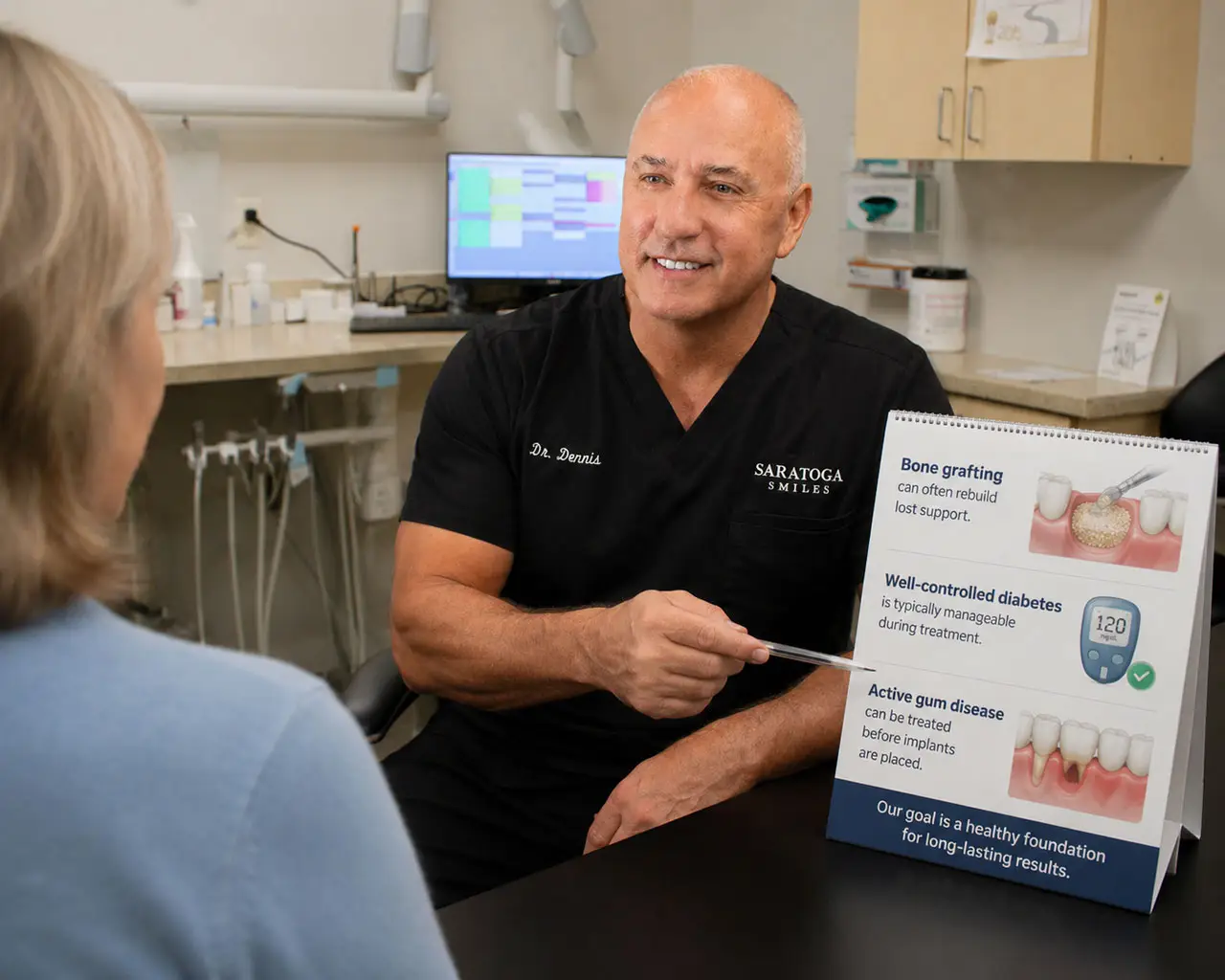
None of these factors automatically disqualify you. Patients with controlled diabetes receive successful implants routinely. But your dentist needs the full picture to plan appropriately.
The CBCT Scan: Seeing What X-Rays Cannot
A standard dental X-ray shows your teeth in two dimensions. For implant planning, that is not enough. Your consultation will include a cone beam computed tomography (CBCT) scan, a three-dimensional image of your jaw that reveals bone density, bone volume, nerve locations, sinus proximity, and the position of surrounding tooth roots.
The scan itself takes about 20 seconds. You stand still while the machine rotates around your head. There is no discomfort, and the radiation exposure is a fraction of a standard medical CT scan.
What the CBCT reveals is critical. According to research published in the Journal of Clinical and Diagnostic Research, CBCT imaging has become the standard of care for implant planning because it allows clinicians to identify anatomical risks and measure available bone with millimeter-level precision.
Your dentist will review the scan with you, often on a screen right in the treatment room, showing you exactly where the implant would go, how much bone is available, and whether any preliminary procedures (like bone grafting or a sinus lift) might be needed first.
Evaluating Your Candidacy
Not everyone is an immediate candidate for implants. But most people who want them can get them with the right preparation. During the consultation, your dentist evaluates several factors:
Bone Volume and Density
The implant post needs sufficient bone to anchor into. If you lost a tooth years ago and the bone has deteriorated, grafting may be needed first. The CBCT scan shows this clearly.
Gum Health
Active periodontal disease must be treated before implant placement. Healthy gums are essential for healing and long-term implant stability.
Overall Health
Uncontrolled diabetes, active cancer treatment, or heavy smoking may require additional steps before proceeding. Your dentist will discuss what, if anything, needs to change before moving forward.
Adjacent Teeth
The condition of neighboring teeth matters. If surrounding teeth also need work, your dentist may recommend a sequenced approach that addresses everything efficiently.
Patricia came to our office convinced she was not a candidate. Her previous dentist had told her years ago that her bone was “too thin.” The CBCT scan showed something different. While she had experienced moderate bone loss in one area, the adjacent bone was healthy and dense. A small localized graft followed by implant placement was entirely feasible. She left the consultation with a clear, staged plan and a timeline she felt comfortable with.
Treatment Planning: What Your Specific Case Requires
Once candidacy is confirmed, your dentist walks you through the treatment plan. This includes:
- Number of implants needed and where they will be placed
- Preliminary procedures such as extractions, bone grafting, or gum treatment
- Type of restoration (single crown, bridge, or implant-retained denture)
- Timeline from first procedure to final restoration (typically 4 to 8 months total)
- Number of appointments and what happens at each one
- Sedation options for patients who want them
The plan is specific to you. No two implant cases follow the same path, and your dentist will explain exactly why each step is necessary.
The Cost Discussion
Implant costs vary based on complexity, and a responsible consultation includes transparent pricing. At Saratoga Smiles, we provide a written estimate that breaks down every component: the implant post, the abutment, the crown, any preliminary grafting, sedation fees, and follow-up visits.
As a fee-for-service practice, we do not participate in insurance networks. However, many dental insurance plans offer partial reimbursement for implant procedures, and our team helps you understand what your plan may cover. We also offer financing options that make treatment accessible without compromising on quality.
The American Academy of Implant Dentistry reports that while implants have a higher upfront cost than bridges or dentures, their longevity and function often make them the most cost-effective long-term solution. A single implant that lasts 25 years costs less per year than a bridge that needs replacement every decade.
Questions to Bring to Your Consultation
You do not need to memorize a list, but having a few questions ready helps you feel prepared:
- How many implants do I need?
- Will I need bone grafting first?
- What is the total cost, and what does that include?
- How long will the process take from start to finish?
- What sedation options are available?
- What is the success rate for someone with my health profile?
- What happens if an implant does not integrate properly?
Your dentist should answer each of these without rushing. If you leave a consultation feeling pressured or confused, that is a sign the practice is not the right fit.
What Happens After the Consultation
You leave with a written treatment plan, a cost estimate, and time to think. There is no expiration date on your plan. Some patients schedule their first procedure within the week. Others take a few months to prepare financially or mentally. Both approaches are completely reasonable.
If you decide to move forward, our team coordinates scheduling, handles insurance pre-authorization paperwork on your behalf, and ensures you have clear pre-operative instructions well in advance of your first appointment.
Take the First Step
The consultation is the hardest part for most people, not because of what happens during it, but because of the uncertainty beforehand. Once you have a clear picture of your options, the path forward becomes much simpler.
Schedule your dental implant consultation at Saratoga Smiles. Dr. Dennis will take the time to evaluate your situation thoroughly, explain your options clearly, and answer every question you have. Call us at (518) 584-5060, or request an appointment online.
—
Reviewed by Dr. Richard Dennis
Related from Saratoga Smiles: This is the implant consultation playbook. For every new patient’s first visit, see 5 facts for launching your new care journey.